If the look of your product is part of what makes it sell, that appearance is worth protecting in its own right. A distinctive shape, pattern or configuration can be copied by a competitor just as easily as a brand name. Once a copycat product is on the market, it is far harder to act against it without registered rights in place.
At IP Guardian, our registered patent attorneys help businesses, inventors and manufacturers across Australia understand what design protection actually covers, how to register it correctly and how to enforce it when someone copies their work. We start with your product and where it is headed, not just the necessary paperwork.
What qualifies for a design right?
In Australia, design protection is governed by the Designs Act 2003 (Cth), administered by IP Australia. Under section 5 of the Act, a design is defined as the overall appearance of a product resulting from one or more visual features of the product. Section 7 says visual features include the shape, configuration, pattern and ornamentation.
To be registrable, a design must be both new and distinctive when compared against the prior art base, which includes designs published anywhere in the world, designs publicly used in Australia and designs in earlier Australian design applications.
New means your design must not be identical to an existing design.
Distinctive means your design must not be substantially similar in overall impression to an existing design.
This assessment is made from the perspective of the familiar person, someone familiar with the relevant product type (whether or not they use it), rather than an expert or an average consumer.
Because Australia operates on a first-to-file basis, the timing of your application matters. Filing before you publicly disclose your design, whether at a trade show, in a product listing or in marketing material, is the safest way to protect your position. It’s also the cheapest insurance you’ll ever buy.
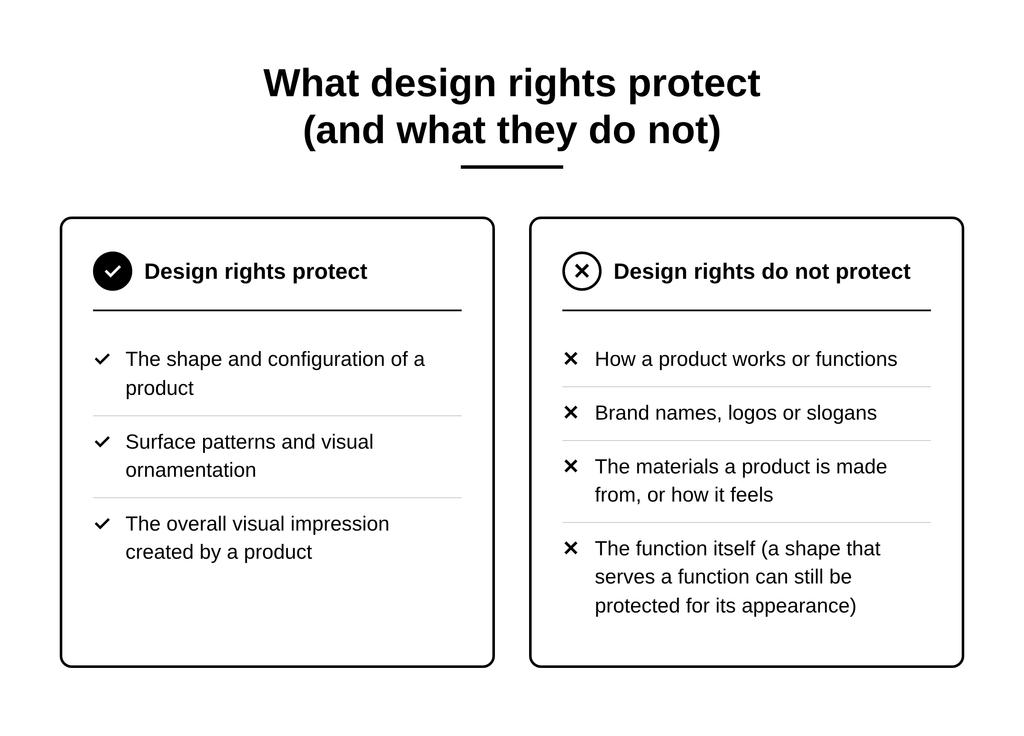
What design rights protect (and what they do not)
Design rights protect:
- The shape and configuration of a product
- Surface patterns and visual ornamentation
- The overall visual impression created by a product
Design rights do not protect:
- How a product works or functions
- Brand names, logos or slogans
- The materials a product is made from, or how it feels
- The function itself (although a shape that serves a function can still be protected for its appearance)
If your innovation is about how something works, that is patent territory. If it is about your brand identity, that falls under trade mark law. Design registration sits alongside both and is often used together with them as part of a complete IP strategy.
How to register a design in Australia
1. Prepare representations
You will need clear drawings or photographs showing the design applied to the relevant product, from enough angles to capture the visual features you want protected.
2. File your application
Your application identifies the product, includes your representations and nominates the owner of the design. At this stage, IP Australia conducts a formalities check rather than a full examination.
3. Registration and publication
Once the formalities check is complete, your design is registered and published on the Register of Designs, creating a public record of your ownership.
4. Request examination and certification
This is the step many applicants overlook. Registration gives you exclusive rights, but you cannot start infringement proceedings until your design has been examined and certified, a process that tests whether the design is genuinely new and distinctive against the prior art.
Only certified designs can be enforced in court, so do this before you need it, not after.
5. Renewal
Registered design protection lasts up to 10 years in total, made up of an initial 5-year term and one renewal for a further 5 years. There is no option to extend beyond that.
How to enforce a registered design
If someone is using, making or selling a product that creates a substantially similar overall impression to your registered and certified design, you have grounds to act.
Enforcement proceedings are generally brought in the Federal Court, and remedies available under the Designs Act include:
- An injunction to stop the infringing conduct
- Damages or an account of the infringer’s profits
- Additional damages in cases of flagrant infringement
As with trade marks and patents, a cease and desist letter is often the first step, giving the infringing party the opportunity to stop before formal proceedings are needed. Having a certified design in hand puts you in a far stronger position at every stage of that process. However, do not threaten legal action until your design is certified. A threat based on an uncertified design is automatically unjustified under the Designs Act, and the person you threaten can sue you for any damage it causes. Get advice before sending any letter.
Common pitfalls to avoid
Here are our tips for avoiding common design protection pitfalls.
Disclosing before filing
Publishing, exhibiting or selling your product before you file can destroy the newness of your design. Since 10 March 2022, Australia disregards disclosures made by the designer or owner (or by anyone who got the design from them) in the 12 months before filing. But many overseas countries have shorter grace periods or none at all, and the grace period will not protect you against a competitor who independently publishes or files a similar design first. Relying on it is a fallback, not a strategy. The safest approach is always to file first.
Assuming registered means enforceable
A registered but uncertified design has not been tested against the prior art and cannot be enforced in court. Businesses sometimes register a design and assume they are covered, only to discover mid-dispute that certification was never requested.
Treating design protection as a substitute for patents or trade marks
A registered design only protects appearance. If your product also involves a novel function or a brand you want to protect, you will likely need patent and trade mark protection alongside your design registration.
Filing representations that are too narrow or too broad
The scope of your protection is defined by what you show in your representations. Poorly prepared drawings can leave gaps that a competitor exploits, and you cannot add new matter to them after filing. Your statement of newness and distinctiveness, if you include one, also shapes the scope of your protection and needs careful drafting.
Letting renewal dates lapse
Design protection is not automatically renewed. Renewal is due 5 years after filing. You can still renew within 6 months after that date with a late fee, but once that window closes, your protection ends early.

Practical tips for safeguarding your designs
- File your design application before any public disclosure, rather than relying on the grace period
- Request examination and certification early if enforcement is a realistic possibility, rather than waiting until a dispute arises
- Keep dated records of your design development process to support ownership and any reliance on the grace period
- Consider whether your product also needs patent or trade mark protection to be fully covered
- If you plan to sell overseas, file in each target country or region within 6 months of your Australian filing date so you keep your priority date (Australia is not part of the Hague international design system)
- Review your design portfolio ahead of renewal deadlines so valuable registrations do not lapse
- Once your design is registered, mark your products with the registration number, but never mark a product as registered before it is
- Work with a registered patent attorney before you file, not after a dispute has already started
IP Guardian, the experts in design protection
Design law involves strict technical requirements and strategic decisions that affect how enforceable your rights will be. At IP Guardian, our registered patent attorneys guide clients through the full process, from assessing eligibility and preparing representations through to certification and enforcement.
We work with designers, manufacturers, startups and established businesses across Australia and New Zealand to build design protection that reflects real commercial value, not just a formality.
Servicing Sydney, Melbourne, Brisbane, Adelaide and the Gold Coast, our team is here when you need us. Contact IP Guardian today on 02 9071 0130.